© Nico Martinez
Too much is dangerous, too little is boring!
Sailing—especially regatta sailing—is a fascinating sport that requires not only mental and physical training but also a solid understanding of physics. The central element in sailing is always the wind, its direction and strength—the kinetic energy that propels a boat. See the geometric diagrams in the free documentation, here: Wind, Water, and Waves(.pdf).
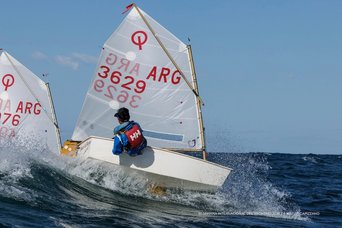
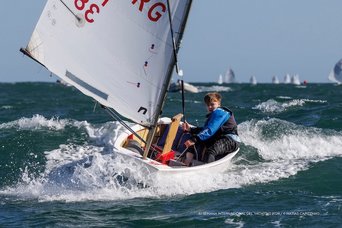
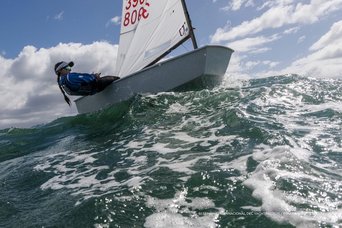
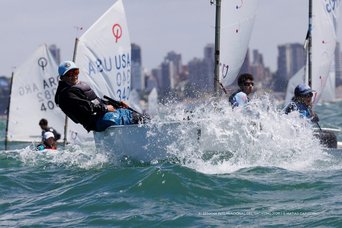
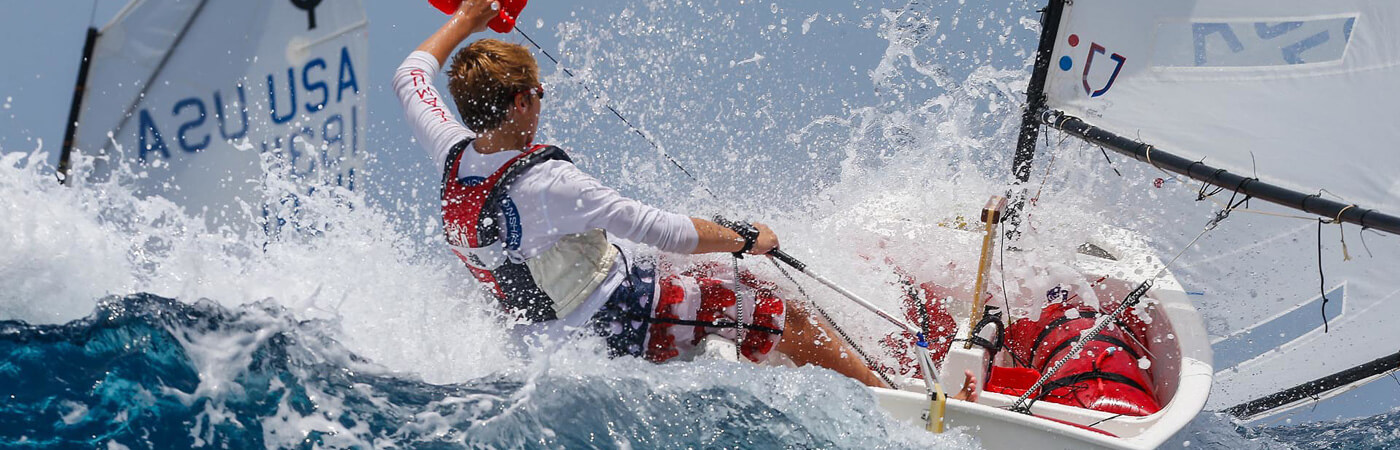
The sailors are fully concentrated on steering their boat through the waves in a controlled manner, despite the wind and waves.
With the wind coming from a 360° direction and at a maximum speed of 8 Beaufort, a boat sailing downwind can reach up to 80% of its maximum speed in the direction of 180°. In contrast, sailing upwind at 45° or 315°, the boat can only reach 59% of its maximum speed.
The water—the current—moves the boat in a specific direction at a specific speed. Even a kinetic energy of 1 m/s feels very strong. The current—kinetic energy—pushes the boat forward in the direction of 180° when sailing downwind, increasing its speed. The current pushes the boat against the wind in a 315°/45° direction, creating a leeward drift.
Waves are created by friction between the wind and the water's surface; they transport energy. The water in a wave doesn't move, but rather the waves transfer their kinetic energy to the water's surface. Wave height depends on wind speed.
Video clips: Watch the free video clips on YouTube: Wind, Water and Waves.
Download the geometric sketches in the free documentation here: Wind, Water and Waves (PDF).
Order: To order the Coach's Toolbox program for Windows and Mac PCs, please visit the following website: click here.